All the stuff you never knew you needed to know about life in rural France.....and all the stuff the books and magazines won't tell you.
Showing posts with label French wine. Show all posts

Thursday, 1 November 2012

Stepping into the Same River Twice


Before Oddbins and Majestic Wine there was Peter Dominic wine merchants, offering a range from the petillant Portugese favoured by students to stuff that was distinctly a grade above.
I don't know whether I was lucky or whether they had enthusiasts as managers in all their shops, but I learnt a great deal from these gentlemen....the best lesson being to trust your own judgement.

Father had a fondness for Nuits St. George which he bought through The Wine Society and had a nasty shock when he bought a bottle elsewhere...it was coarse and heavy, the colour staining the glass.

Yes, said the Peter Dominic manager when I told him. No surprise at all. They're cutting it with the Red Infuriator...stuff from Algeria.

They're all at it.... coarse stuff from the Languedoc to stretch the Rhones, better stuff from the Rhone bolstering the Bordeaux.
Never trust a label. Trust your own judgement. If you think it's foul...it is.

As I was to learn when moving to France years later, nothing much had changed, nor has it to this day, but at that point it hadn't crossed my mind to move to France, nor had it crossed the mind of a devotee of Chambery vermouth and Pouilly Fume that I would like a dessert wine when the manager of the branch I then frequented produced a bottle from the fridge.

Go on...you'll be surprised.

I was... it made me think of honey and orange, it sent wonderful smells up my nose and it was anything but heavy. I hadn't tasted anything like it.

Moulin Touchais. Coteaux du Layon. Twenty years old.

I bought what they had until the branch closed and my Moulin Touchais was no more.

And then one day I moved to France.
I looked in various areas: Brittany, the Limousin, the Charente and, not finding what I wanted, moved on to the Loire Valley.
In hindsight it is clear that the other areas did not come up to the mark because my unconscious mark was the Loire Valley itself!

I saw all sorts, then found an estate agent whose method was to allow you to look through files of houses printed in black on coarse yellow paper, pick what you wanted and then send you off with keys...where they existed....and general directions, broad finger on the map...we are here and the enemy is there.
Just the style I loved. Thanks to him I was off the beaten track, getting to grips with what was behind the tourist facade.
I was frequently lost and on one occasion pulled up on a hillside..... a stumpy stone building on the hill above, vines below and a river running at the bottom....the River Layon, upon whose Coteaux I was sitting.

Though I did not buy a house in the Layon area, I used to frequent it....buying wine, visiting friends....and grew to love its quiet beauty.
Near the source was an artifical lake where the surrounding, undrained fields were a paradise of snakeshead fritillaries in the spring and I used to take a detour at that season in order to enjoy them on my way to visit friends at Passavant sur Layon, where the successor to Foulques Nerra's castle dominated the river crossing....the only modern day marauders the holidaymakers eager to buy their wine from a chateau!


Downstream was  Clere sur Layon, nestling in the valley among its vines, its roads made perilous by the lorries running to and fro the vast quarries behind the village, the drivers on piece work and stopping for nobody.

Downstream again to Nueil sur Layon....for the annual horse racing up at the Chateau de Grise before it was sold to the Japanese who stripped it of all its staircases, fireplaces and ornamental detail and sold it on again to be a hotel. The project failed...and such was the low price put upon it by Credit Agricole that I thought of trying to raise the money.....but of course, Credit Agricole had a purchaser all ready...a local bigwig given a present on a plate.
It was in Nueil that I first heard of the festival of Quasimodo.....wondering what on earth this could be - and how it would be celebrated - I was half reassured, half disappointed to learn that it was the first Sunday after Easter, when the introit to the mass of the day began 'Quasi modo....'

Racing was popular...downstream again, on the way to Les Verchers sur Layon was the Chateau d'Echeuilly who also had an annual race day, but that too finished before I had been there long.
I had friends in Les Verchers, whose church spire marked for me the transition from the tiled roofs of the south to the slates of the north, one of whom used to lament that she would have been living in a chateau if her uncle hadn't blown his money in Paris on what was discreetly referred to as paying Mistinguette 'to sit in his car'.

Above Les Verchers the bluff rose steeply, barring the way to the Loire via Doue la Fontaine and the Layon took a right angled turn under the steep hillside, cattle grazing the fields alongside as the road followed it toward Concourson sur Layon, a quiet, nondescript village -claim to fame a site for camping cars. But there's a lot more to Concourson than a pumping station for caravan loos.
The building above is similar to the one where I once again stepped into the same river....and it is a limestone furnace, for here the quiet Layon was once a hive of industry, running through an area of coal seams.
Shallow pits were dug...some of the airshafts are still visible...and local men would make a contract with the landowner to dig until the seam was exhausted and then return the land to its previous state.
The coal was used to heat the local limestone to reduce it to lime which in its turn went to the building trade...and on the fields.

France being France, in the mid eighteenth century the royal government decided that while individuals might own what was on the surface, what was under it belonged to the state, who could thus issue licences for its exploitation....and, despite revolts and resistance, managed to impose this new scheme on the Layon coalfields. The new wealth generated can be evidenced by the Chateau des Mines, still,  I believe in the hands of descendants of the mine owners.
Transport was always a problem, and in the later years of the eighteenth century the Layon was canalised, from Concourson down to its confluence with the Loire at Chalonnes, involving as many as twenty four locks, the project being under the protection of the brother of Louis XVI...known as Monsieur, the customary way to refer to a king's next youngest brother...and thus known as the Canal de Monsieur.
Monsieur was to become Louis XVIII at the restoration of the monarchy after the fall of Napoleon, but his canal fell victim to neglect and destruction in the wars of the Vendee and was not, itself restored.
There is another link to that period in that one of the administrators of the mines based round St. Georges was the Comte de las Cases who as a boy acccompanied his father to St. Helena with Napoleon....and who went to great lengths to try to challenge Sir Hudson Lowe, Napoleon's gaoler, to a duel after the death of the Emperor.

No sign now of the locks as the Layon runs south of Martigne Briand, the chimneys of its chateau visible for miles around

And heads north through the vineyards to the pretty villages of Thouarce and Rablay d'Anjou, the latter a haunt of artists, on its way to St. Aubin de Luigne and Chaudefonds sur Layon, the heart of coal production, with seams running out under the Loire at Montjean and Chalonnes, where the Layon slides into the turbulent waters of the Loire.
 
But with all this talk of water....where is the wine? The Coteaux du Layon? The wine which tempted you into reading this post?
 
It is all around you as you travel downstream....from Passavant to Chalonnes you are on a river of wine: the dessert wines of the Coteaux du Layon; dry Anjou Blanc from the same grape, the Chenin, as the dessert wines; Anjou Rouge from, predominantly, the Cabernet Franc and with a bit of luck the pale wine from the Grolleau Gris.
 
A river into which you can, indeed, step twice.


Sunday, 29 July 2012

French villages. The Beautiful and the Banal.


The French television chain, France 2, has had a competition to choose France's favourite village from 22 preselected to represent the various regions of the Hexagon.....and the votes went in favour of Saint-Cirq Lapopie, in the Lot in south west France.

It seems that the mostly French voters had the same idea of what constitutes a favourite village as the foreign tourist....there have to be narrow streets, preferably cobbled, geraniums must be launched from every window and the place has to be gussied up to within an inch of its life while a chateau doesn't go amiss either....

So I suppose it was the possession of a well known chateau which tipped the balance for the Pays de la Loire candidate in favour of Montsoreau, alongside the Loire, though it has a dearth of geraniums, few cobbles and a main road running through it.
As for the gussying....my own theory is that the monthly brocante market on the riverside is held to hide the true ghastliness of the place.
Visitors always want to go there...but not twice.
One encounter with a trader intent on selling you a so called Quimper chamber pot with an eye in the bottom at a price that has your own eyes watering is enough for even the most hardened tourist.


My vote would have gone to one of Montsoreau's neighbours - Turquant - even if its chateau isn't associated with the novels of Dumas.
It has two places where I used to buy wine, for a start - and wine had to be good to get me to travel miles to get it - though while this personal note would weigh nothing in the scales the vignerons' places of business certainly would.
The man who made one of the best dry white wines in the region had his cave in, literally, a cave.


You can see it above, last on the right, alongside the house. The cliffs overlooking the Loire have been hollowed out both for building stone and deliberately to create dwellings since far back in time and some of the caves contain decidedly sophisticated houses.
When I was first in France, no one wanted to live in them any more....they preferred a nice new breezeblock bungalow  in a development...so they were going for a song.
By the time I left they had become trendy des res for Parisians and arty types with the dosh to pay the astronomical prices demanded.
My vigneron had lived through it all and just used his cave for storing his wine....the walls were black with the mould deemed indicative of a healthy balance of temperature and humidity and the wine was superb.
.
The other vigneron produced red wine and lived in the village. The houses on either side of the quiet road that leads up from the river to the vineyards above are built of the local stone and glow softly gold in the afternoon sunshine, wallflowers blooming red and yellow in the cracks in the blocks and the breaks in the crepi. There are even geraniums in summer...though only in window boxes.

And to my mind the chateau has a lot more going for it than the one at Montsoreau. That one has only the Dumas connection now that the museum of the Moroccan troops has moved out, while the chateau at Turquant housed Ben Bella, freedom fighter and the first president of independent Algeria in the six years of his captivity in France after he was kidnapped by French colonial forces.

So why do the French televison voters go for Saint-Cirq Lapopie?
Because it as different as possible from their high rise flat in town...and  from the village of their grandparents in La France Profonde.

For example...St.Ragondin.

The most banal village in France.

A square where there is a market once a month.
One veg stall.

Where the hairdresser has closed down for lack of custom.

The chemist could find no one to take on the business.

The dentist likewise.

And don't even think about putting out the umbrellas on the pavement outside the caff   'le Pot de Vin'...the local English would nick them.

So, enjoy the most beautiful villages in France...but don't believe that that they are alive.


Enhanced by Zemanta
ll known

Tuesday, 15 November 2011

Wine that maketh glad the heart of man....


Particularly the British expat in France, some of whom bear out the view of  Dr.Johnson that few possess the intellectual resources to allow themselves to forego the pleasures of wine as otherwise they would be at a loss to know how to pass the  interval between lunch and supper.

Still, at least they are relaxed about wine...they know what they like and enjoy what they know.

Chez the producers, however, it is a different ball game.

In theory the quality of French wine is maintained by strict regulation, controls and inspections, reflected in the price of the finished product.
The major guarantee is that of the A.O.C. ...the Apellation d'Origine Controllee... which links a product to a geographical area.
The best known example among wines is Champagne....whose producers throw legions of well paid lawyers at any sparkling wine that indicates it is made in the same fashion by using the word 'champagne' on its label.
Thus the labels proclaiming 'Methode Traditionelle'.
The wine that dares not speak its name.

How far the theory stands up in practice is open to question. The wine is blind tasted...but that's before it's bottled and there's many a slip between cup and lip, not to speak of the possibilities of the impossibility of refusing old Jean-Paul's wine as he is your wife's cousin, not to speak of his membership of the ruling party's local branch and his son being the local senator's gopher.

Now, when we think of wine we tend, thanks to tradition and publicity, to think of something that is the product of man's intelligent use of natural resources.
Deep soils are best suited to grain, so shallow, stony, poor soils can be given over to other uses...such as growing vines.
The wines produced from some of these soils can be magnificent...depending on the grape variety and the exposure to warmth.
They can also be total rubbish...

They are all the more likely to be rubbish when a particular A.O.C. becomes fashionable and pressure mounts for land originally outside the A.O.C. limits to be included.
The fate of Chablis and Sancerre, not to speak of Chinon, speaks for the results.

Recently, the growth of interest in 'bio' wines has provided a further complication.
These producers refuse to use the chemical treatments imposed by those running their local A.O.C. committees...worse, they refuse to cough up their contributions to the regional syndicats which take their money and promote the produce of the big firms.
Those who delight in the little ways of France will be entranced to hear that these contributions are described as voluntary and obligatory.
They prefer to sell their wine as 'vin de table'...the lowest rating above industrial alcohol.

Now in my time in France I had come to learn that vin de table could be decidedly drinkable.
In the age of the wine lake - before the European Union gave grants to turn it all into vinegar instead - surplus wine was supposed to be 'stripped' of its character and sold as table wine.
As you can imagine, producers and middlemen did nothing of the sort, so batches of 'vin de table' would arrive on the shelves from all over the place - in my area mostly from Italy via bottlers in the Maine et Loire - distinctly unstripped of their character.

The idea was then that you, spotting a new consignment, would buy a bottle, take it to the car park and taste it...a process made easy by the plastic stopper on the bottle.
If you decided that it was a wine to your taste - and there used to be unmistakable Barolos in these bottles - you would grab a trolley and load up, being careful to check the batch numbers to avoid the possibility of an unlooked for encounter with something sulphurous from Sicily.

I remember fondly another vin de table...this time a legit one from Languedoc...whose label showed a gnarled vine root, which on closer inspection after sampling the contents revealed itself to be a vegetative clenched fist...a true Red wine!

In my last few years in France, younger vignerons were experimenting with grapes unauthorised for A.O.C. rating in their area.....my local man had a plot of Pinot Blanc which made a superb white wine. It never made it to bottling stage as his customers were clamouring for it from the moment it finished fermenting and he could command a good price - so much for the A.O.C.

It is well said that good wine needs no bush.
These independent minded producers can sell their vin de table with ease. They have waiting lists of customers in some cases, both in France and abroad, and this does not go down well with the authorities.
This being France, boxes have to be ticked and beaurocrats employed.
Systems have to be respected.

So one vigneron in particular has found himself in deep doodoo.

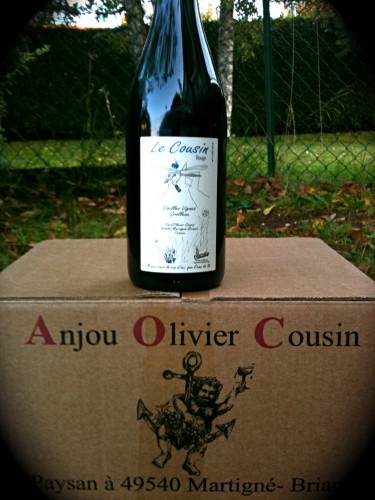
Olivier Cousin of Martigne-Briand in the Maine et Loire.

Carrying on the family tradition of natural production methods and refusing to stay in the box provided he has had nothing but problems with the authorities for years.
For not paying his contributions he has been effectively bankrupted by the state...his accounts frozen.
Forbidden to indicate the geographical origin of his wine he has flirted with ways of giving a hint....he has labelled some wine 'Pur Breton'...Breton being the local name for the Cabernet Franc grape...he has given the name of his village...and, in one last cocking of snooks, he has labelled his wine boxes...not the bottles...

Anjou Olivier Cousin

A.O.C.

He faces a fine of over 30,000 Euros.
To be paid, one supposes from the accounts the authorities have already blocked.


Enhanced by Zemanta

Tuesday, 28 September 2010

So we'll go no more a-roving....

The Great VineImage by Steve Parker via Flickr
I little thought, last year, that it would be the last time I would ride the tractor out to the vines...clinging on to the wheelarch for dear life and reassuring myself that the jolts were good for the liver...if not for the living.
But Guy has sold his last parcel of vines and the old gang has broken up. (here)

I have picked grapes with one friend or another nearly every year since coming to France (here) and I will miss the fun, the gossip, the drinks breaks and the satisfaction of going off with the freshly pressed juice to make pineau the same night - before attacking my hands with bleach and my joints with Radox.

But time passes, we and our friends are getting older and it is now a question of whether we outlast our cellar or our cellar outlasts us..so not only am I not picking grapes, I am not even 'doing' the wine fairs...the autumn promotions mounted by the supermarkets where you can buy wine to lay down...mainly Bordeaux...as well as everyday drinking stuff.

It used to be quite an operation.
First, thanks to the compartmentalism of France, you had to have friends on the other side of the departmental border with whom to exchange the publicity brochures in order to check prices and offers...there could be a difference of as much as 5 euros in the price of the same bottle...followed by a swift reconnoitre to check that the wine offered was not already on the shelves at a lower price.

The first time I went to a supermarket wine fair I found the wine I wanted and tried to attract the attention of the 'sommelier' in the black apron supposedly running the show, which took some doing as he was busy opening bottles for what appeared to be a group of his cronies.
I showed him the wine I was interested in.

Ah yes.
Could I taste it?
No, I could not.
But if it is O.K. I want to buy four cases.
You still can't taste it. It's expensive.
But I can taste the cheap stuff that's been oxidising in the open bottles?
Certainly!
What about those bottles you've just been opening? Aren't they expensive?
Yes, but these are well known clients.......yes, to judge by the purple noses and broken veins, I just bet they were.....

Well, in those days my French wasn't up to being more combative so I backed my hunch, based on the reviews, and ordered my four cases.

The chap in the black apron solemnly took my details and said he would be in touch.
He wasn't.

I got in touch with him and he revealed that for the whole of the chain of supermarkets of which his was but one franchise the total allotment of that particular wine was three cases.

So why had they advertised it?

It brings in customers.

What about my order?

Well, I couldn't have what they hadn't got even if they had sold it me.

French logic.
It would never pass an exam.

Consumer protection has improved since that time....they now have to state how much they have for sale in the publicity leaflet...but you still have to watch them on  prices.
I liked one particular Bordeaux, which had been stocked on the shelves before the wine fair and was then transferred to the fair for the duration.
It must cost an awful lot in man hours to move four dozen bottles from one shelf to another as the price had gone up by over 70 centimes by the time it arrived at its' destination.

It doesn't do either to go to a number of wine fairs in quick succession and then forget at which one you bought the bottle you like when you finally get round to tasting it.
This has led to a tour of supermarkets carefully bearing the empty bottle, to try to find its' colleagues.
If you are thick skinned, or dedicated, you can ignore the looks you are getting from other clients, but you need some facility in French to explain to security why you are to be found in the wine aisles with an empty bottle in your possession.
Most of them finally twig that if their supermarket doesn't stock it you couldn't have pulled it from the shelf and drunk the contents, but there are some so dense that only the intervention of management has saved me from being frogmarched through the checkouts to the applause of the multitudes to await the attentions of the gendarmerie.

The dear departed days of the wine lake used to turn up bargains for everyday drinking.....those bottles with five stars and a plastic cap could harbour some very nice stuff indeed, usually produce of Italy, but you never knew what sort of consignment had been delivered.
One sure sign was that the shelf was nearly empty, but that was a bit late to find out, so, if the shelf was relatively full the best idea was to buy a bottle, sample it in the car park and, should it prove to be the real Italian Job, rush back in and buy everything with corresponding serial numbers on the label.
If it wasn't, then you had something with which to strip paint.

I think the European Union are paying winemakers to turn their surplus into vinegar these days...I know winemakers who could turn anything they touched to vinegar...and proved it regularly in the stuff they sold to the public....so it's nice to know they have achieved EU recognition at last.

Growing up in the U.K. before climate change, grapes were something that grew on the vine in Hampton Court, and wine was made from flowers, fruit and vegetables.
Before the French get all sniffy about calling these wine they should try some....I fondly remember wine made from oranges, from gorse flowers, from mangelworzels and from elderflower, though I could never master elderberry wine...it always turned out to have a metallic taste.

My first acquaintance with it was when of primary school age, when visiting my mother's mother.
She had elderly neighbours who were famed for their tomatoes - green house grown in those far off days - and their elderberry wine - supposedly of such strength that it would remove your socks at ten paces.
Every morning, nattily clad in striped pyjamas and slippers the husband would stroll from their kitchen door to the green house with an uncovered chamber pot in his hand, which was said to account for the vitality of the tomatoes and, according to my grandmother, the chamberpot played a role in making his elderberry wine too, though I never believed this as they did not have the air of a two chamberpot family.

At that time, insurance companies did not lurk in town centre offices, but sent out agents on bicycles to drum up business and to maintain it, once duly drummed, by weekly visits to their customers.
The man from the Pru called next door on his weekly rounds and I was in the front garden while my grandmother gossiped to a passing friend over the gate.

'I give him ten minutes before he comes out.....so he'll have had a glass of her wine!'

True enough, after some ten minutes the agent emerged and headed for his bicycle. I think if he had not attempted to put on his bicycle clips he might have been all right, but as it was he fell heavily into the privet hedge, heaved himself out again and rode away like a clown on a unicycle, his trilby hat neatly adorned with twigs.

The two ladies eyed each other meaningfully. Clearly the Pru would not be getting their insurance business.

From teenage years, I was allowed a glass of wine with Sunday lunch, although my father's preferred sweetish Penedes from Spain was perhaps not the best choice to accompany the roast, and as a student, having decided that I couldn't drink beer and stand up at the same time, I followed the hallowed route of Mateus Rose that we all brought to each others' parties.

Departmental wine and cheese parties were catered by Sainsbury, featuring hock and moselle, so it wasn't until I decided to learn to cook as an alternative to a diet consisting of boiled eggs or a Fray Bentos steak and kidney pie when the dibs were in tune that I started to take more of an interest in wine,  inspired by Elizabeth David and Patience Grey who seemed to think it abnormal not to be swilling something while at the trough.

A super manager at a Peter Dominic branch helped me along...a real enthusiast who loved what he sold and showed me what to look for in terms of quality regardless of the price of the bottle.

He also put me wise to the then widespread adulteration of French wine.....Rhones bolstered up with a shot of Algerian...the Red Infuriator as he used to call it....Bordeaux given a boost by something hefty from the Languedoc...and although all this is supposed to have been put a stop to, Andre who worked in the wine business for years, tells me that it still goes on, just the sources change.

Later, having made contact with the world of the function waiter, I was to discover what wine could really be like.
These chaps worked as freelances, through some sort of agency, at banquets of the classier sort, including the Mansion House and Buckingham Palace, serving wine.
There was some sort of percentage allowance for breakages on these occasions, and this percentage, carefully unbroken, would leave the premises with the function waiter, to be sold.
These bottles were not cheap.....but I have never since been able to afford wine of that quality.
Most bottles were labelled, first and second growth Bordeaux, premier Cru Burgundies, but the best, the stuff that had been imported in cask and bottled in situ bore no labels, just a mark of white paint on the bottle to indicate on which side the lees were to be found.

I certainly found nothing this good when I moved to France, nor could I have expected to do so, but in view of the technology in use locally they did not do so badly.

No specialised wine yeast was used...the wild yeasts on the grape were what did the job and they would vary from year to year...while a temperature controlled vat was something unheard of.
When wine yeasts did come in I had the privilege of witnessing their first appearance at a local chap's vineyard.
His wife had produced a baby's bath, and he was testing the water with his elbow to judge the right degree of warmth to encourage the yeast to develop.

Mark you, with all the financial backing and hi tech equipment at their disposal, the stuff the top rated winemakers make these days certainly can't beat what they used to produce when the idea was to make something to drink rather than something to trade.
At least the local guys have kept both the baby and the bathwater.

So no more trips on the tractor, no more battling round the wine fairs.........whatever am I going to do with myself?


Enhanced by Zemanta

Wednesday, 17 February 2010

A burger and a glass of wine...

Swiss Burger with Pickled Red Onions and Frisee.Image by millhouseloves via Flickr
The National Front - right wing party - is accusing President Sarkozy of helping to bring about the 'islamisation' of France...yet another bit of ugly fall out from the debate about national identity.
What has he done? Forced Carla to wear the burqua? Worn it himself? Circumcised himself? Nothing so spectacular...just something the National Front think is more insidious. Islamisation by hamburger.

It has discovered that the fast food chain 'Quick' is serving only halal meat in eight urban branches, where there is a high incidence of muslim customers, including its' branch in Roubaix. The maire of Roubaix  - not National Front -says he doesn't mind them serving halal products, but to serve only halal products is discriminatory. The National Front say a lot more than the maire of Roubaix.

'Quick' changed hands not that long ago. It used to belong to a friend of Sarkozy, one Monsieur Frere.
The National Front say, however that when  the company was put up for sale, it was valued at five hundred and fifty million euros and a generous buyer paid eight hundred million euros.

Who was this generous buyer?
None other than a subsidiary of the state finance organisation the 'Caisse d'Epargnes et Consignations'.
Thus Sarkozy, as head of state, is leading an 'islamisation' policy. In the view of the National Front.

Not content with this, the party also complain that by nature of  'Quick's policy, the state is levying an 'islamic tax'...the obligatory fees paid for halal certification of meat to the appropriate muslim bodies.

I never thought that fast food could be so interesting.

In any case, no one is accusing 'Quick' of adulteration, whereas in the world of French wine that nasty old habit has reared its' head again.

Gallo, the Californian based wine firm, bought what it thought was wine made from the pinot noir variety from firms in the south of France, It has turned out to be just the local plonk which adopted a higher class name to attract a higher class price. Those concerned, vignerons, brokers, wine merchants and others, trousered between six and seven million euros between them....O.K., small beer beside what was trousered by M. Frere, but then they're not friends of the President of France.

There have been wine scandals for years...Algerian wine propping up wine from dubious years in the Rhone Valley, wine from the south fortifying the proud names of Bordeaux when conditions were unfavourable.
Not just for home consumption...this stuff was exported.
I can remember when proper labelling controls were introduced in the U.K., 'Nuits St. George'  disappeared overnight. I think it was O.K. to sell it as what it actually was, blended plonk, but not as as 'Nuits St. George'.
Mark you, a Loire Valley firm has just been taken to court by New Zealand producers for selling its' sauvignon blanc as 'Kiwi Cuvee' on the U.K.market...thus attempting to cash in on the reputation for quality of New Zealand wines....remember the fuss about trying to sell anything other than wine from Champagne as champagne?

It's not just on the grand scale, either.
About three years ago, a local firm was fined for getting the desired 'oak barrel' flavour into its' red wine by dumping oak chips in the steel vat.
Andre, retired worker in a local winery, was not impressed. This had been going on for years, once local vignerons made contact with foreign buyers who didn't want to pay top dollar for a wine from Bordeaux when one from the Loire at half the price would do as well, with a little tweaking.
He remembered that his firm had a contract with a well known U.K. wine merchant for red wine in which blackcurrant twigs had to be steeped, to acquire the 'berry' scent desired by the customer as a sign of quality.
I told him that Australian wine had to have a label listing everything that went into it. He shook his head, pityingly.
Never happen here,' he said.  'And you really don't want to know.'

The old business of shipping tankers of wine round the country still goes on, despite all the checks that are said to be in place.

There was a vogue a few years ago for celebrities to buy vineyards, where they could pose in open necked shirts among the barrels, and, let us not forget, cash in a bit by selling their produce to admiring fans.
A friend is a great fan of one such celebrity, and nagged her husband to take her to see his vineyard, a pretty-pretty operation deep in the countryside.
They returned with a box of six bottles - the smallest unit of sale, it appeared - which, given the apellation concerned, had cost an arm and a leg.
The bottles were left to settle, and before they left again for the U.K., they invited friends round for a meal to sample the nectar.

You must have been in that situation. The wine was dreadful. What do you say?
Luckily, the husband is a man of quick decision. He rose from the table and cleared the open bottles.
'Rinse out your glasses....I'll get something decent.'

Intrigued, I asked Andre, the man with the answers in the local wine world.
'Well, just look at the amount he sells. No way can all that be produced here. The guy running it for him is good...his proper wine can win medals...but for selling to mugs like your mates, any old thing will do. He buys in from all over.'

Not that medals are all they are cracked up to be, according to Andre.
In his view, you could trust anything winning at Brussels or at Macon, but nowhere else. You get medals for being better than the others, not for being outstanding, at most of the fairs.
Further, vignerons out to make a name for themselves make special vats for going round the shows and you won't necessarily find the same stuff when you go to buy.

Listen to Andre and the whole edifice of French wine and its' mystique crumbles before you.
I should take him for a burger in Roubaix.
Reblog this post [with Zemanta]

Tuesday, 21 April 2009

We're out of wine.

When I was a timid newcomer to the French rural scene, the cry of

'We're out of wine!'

would mean a trip to the supermarket. That was where I was accustomed to buying wine when I was a tourist, so that was where I went. It also meant that I could just grab the bottles and pay without having to stretch my French beyond "Bonjour' - and why is it never 'Bonjour, Madame" when you greet the cashier and always 'Bonjour, Madame" when she greets you? It's not just me, it's French too, just listen next time you shop.

In the matter of choice, the local supermarkets could not beat the wine stores of the U.K. where the world's wine was displayed for my delectation...in France, at that point, only French wine was available. What else would the French consumer buy? Well, Algerian and Tunisian, but they counted as French thanks to colonial history and all the old boys who did their national service in North Africa wanted pink North African wine to go with their spit roasted lamb - the 'mechoui', while they gathered together to recall the horrors of the colonial wars....

'Do you remember, Georges, courgettes every day for lunch....."


M. Untel changed my wine buying habits. He was an ex gendarme who was ex because he had managed to go too far even for a gendarme in breathalysing the local doctor when he, M. Untel, having drink taken, was having to hold on to the gendarmerie van for support while proffering the balloon. The doctor was not amused...he was out on an emergency. Consequently M. Untel had the choice of a posting to Devil's Island or retirement on full pension. He was the rep for a co operative selling vegetable seeds when I met him...a bit like


Avon calling!


but preceded by a strong smell of drink and accompanied by the clanking of the bottles he had brought with him to while away the time it took to take my seed order. Thinking about it, his technique could revolutionise door to door cosmetic sales or Tupperware parties. I see it now...... M. Untel, brick red in colour from exposure to the sun and the long term effects of alcohol, surrounded by palpitating ladies, producing the company's latest plastic must-have item........a long plastic spike with a round base upon which to impale empty bottles to make sure of gathering the last reluctant drops of wine. They would be so overcome by the fumes that they would buy anything.


On this occasion, while I was dithering between the Triomphe de Farcy and the latest amazing stringless -ready -for -the- freezer green bean, he asked me what I intended to do with the heap of empty bottles at the side of the house. They had been there when I bought it, they were not in my way, so I had left them alone...there were higher priorities than shifting hundreds of old bottles. The snort told me that I had got my priorities wrong. Those bottles were for filling. With wine. With local wine. From local vignerons. He took me to look at the contents of the boot of his car. It was packed to the gills with bottles of wine, all corked, but not one of them with a tax capsule. This was what the heap was intended for. He closed the boot. I asked him if he wasn't worried about being stopped by his former colleagues. He was not.

'It's for them.'


He would introduce me to a suitable vigneron and then, once I knew what the form was, I was on my own. First, however, I had to wash all the bottles and buy plastic containers. He would lend me a hedgehog. This was becoming surreal. Thoughts of Alice in Wonderland and the flamingos were going through my mind.


I started on the bottles, soaking them in the granite trough by the barn, brushing them out, holding them to the light and then repeating the process until what could be cleaned was clean as a whistle. It was a horrible job...those bottles had been there a damn long time and had become home to sundry living creatures, or creatures that had once lived. M. Untel arrived with his hedgehog, which turned out to be a contrivance about three foot high with circular rows of spikes upon which the washed bottles could be upturned and dried.

The next day he turned up with plastic containers...like the ones I used to use for water when camping, with little taps at the bottom, except that these held 20 litres apiece. I could use these,which he called 'cubis'. He also produced a bottling machine...a thing with a hole into which one fed a cork, put the full bottle on the stand underneath and swung down with all one's might on a lever, thus forcing the cork into the bottle. He gave me sage advice.

'Soak the corks in warm water first or you'll do yourself a mischief'.

We were off to see his neighbour to buy wine. He would show me how it was done.
We arrived at a farm, and a small man in cap and overalls greeted M. Untel with pleasure and regarded me dubiously.
Was I a security risk? Goodness only knows how these foreigners gossip giving rise to problems with taxmen. He was reassured by M. Untel that I didn't have enough French to get anyone into trouble, and the ceremony commenced.

We were led into his barn, where huge concrete vats covered the walls, and, in honour of the presence of a lady, the tasting glasses...well, tumblers...were wiped out with a cloth. We started with the dry white chenin , we proceeded to a dry pink then a sweeter pink , we returned to a sweeter white, then switched to a red merlot, then a red cabernet franc and finished on a dessert wine. At no point was a spittoon provided.

What would I like to buy? I had two cubis, so I could have two choices. I took the dessert wine and the dry white, and they were duly filled from the vats. I paid, in cash, of course, and the cubis went into the boot.

At home, I filled the bottles with a funnel, soaked the corks, and M. Untel helped me with the bottling process...I was grateful as I was not at all sure that I had the strength or the technique required for that part of the operation. Satisfied with his day's work of cultural integration he gathered up his cubis, his bottling machine and his hedgehog and headed for home with a final injunction.

'Mind now, no more buying in supermarkets!'